Grub damage looks like drought at first. Watch for these signs before the damage spreads.
Irregular Brown Patches That Water Won’t Fix
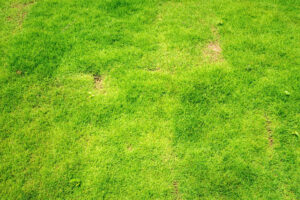
Grubs chew off the roots, so the grass can’t take up water. Patches turn yellow, then brown, in uneven shapes. Watering revives drought-stressed grass. It can’t save grass that has lost its roots. In Texas, grub damage can appear any time from June through October.
Grass That Pulls Up Like a Carpet
Grab a handful of brown grass and tug. Grub-damaged turf lifts with almost no resistance and very few roots. In heavy infestations, you can roll the sod back like a rug. The white grubs sit in the top few inches of soil underneath.
Soft, Spongy Turf
The lawn may feel loose when you walk on it. The root layer no longer anchors the sod to the soil.
Birds, Skunks, and Armadillos Digging
Animals often find grubs before homeowners do. Birds peck holes through the turf to reach them. Skunks dig small, cone-shaped holes, sometimes dozens in a single night. Armadillos tear up larger strips of sod. Texas A&M’s AggieTurf program lists this digging as secondary grub damage.
Animals will dig even when grub numbers are low. Treat the digging as a clue, then confirm with a soil check.
Grass That Won’t Green Up in Spring
Grubs stop feeding once the soil cools in fall. The damage often stays hidden until spring, when patches fail to green up. By then, the grubs have finished feeding for the year.
Grub Damage or Take-All Patch?
Take-all patch is a turf disease that can look like grub damage. Check the roots to tell them apart. Take-all patch leaves roots rotted. Grubs leave roots chewed short or gone, with C-shaped larvae in the soil. Treating a disease with an insecticide wastes money and fixes nothing.
How to Identify Grub Worms and the Beetles Behind Them
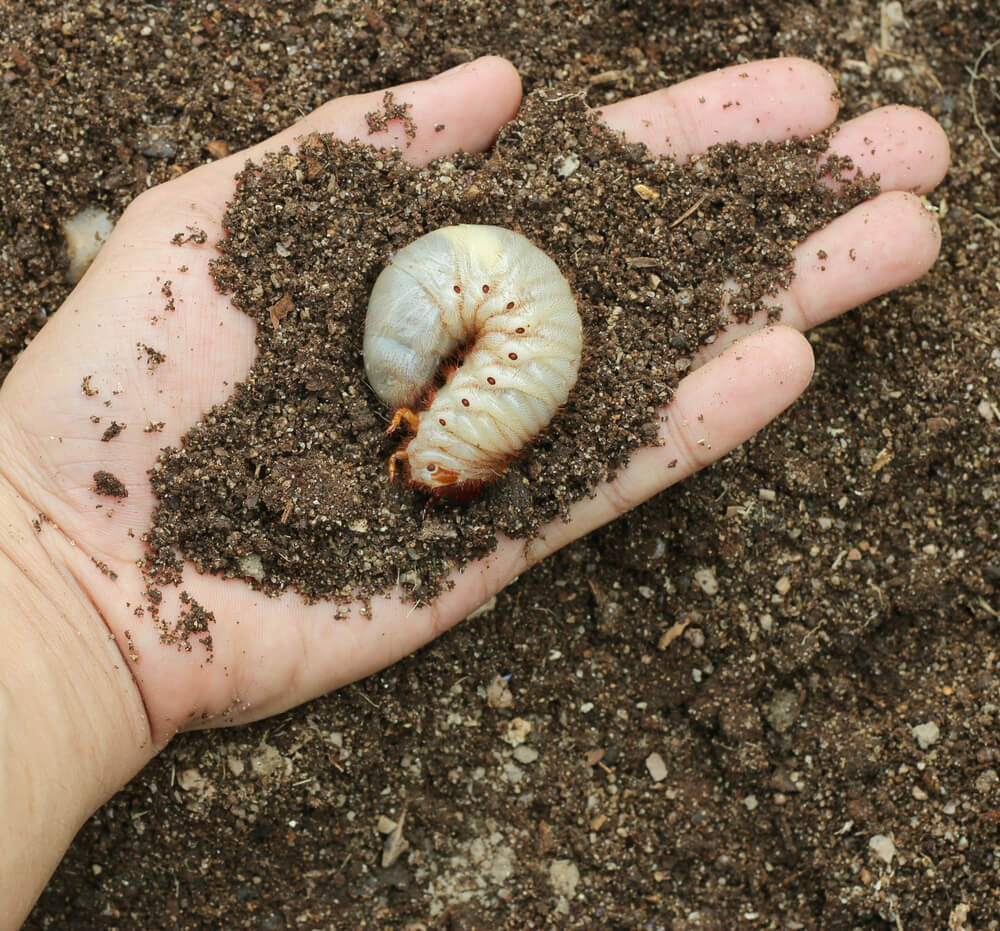
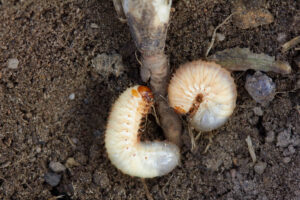
Grub worms, also called white grubs, are the larvae of scarab beetles. They are creamy white and curled into a C shape. Each has a brown head and three pairs of legs. Full-grown grubs reach 1/2 to 1 inch long.
Texas has almost 100 species of these beetles, but only a few damage lawns. These are the ones Weatherford homeowners are most likely to find:
- June beetle (Phyllophaga crinita): the most important lawn grub in Texas.
- Southern masked chafer (Cyclocephala lurida): common, but less destructive per grub.
- May beetle (Phyllophaga congrua): prefers cool-season grasses and takes two years to mature.
- Green June beetle: large grubs that eat organic matter, not roots. Their tunnels can still loosen turf.
Grubs readily attack the warm-season grasses common in Weatherford yards. That includes bermudagrass, zoysiagrass, St. Augustinegrass, and buffalograss.
The White Grub Life Cycle in North Texas
Most lawn grubs in Texas complete one life cycle per year. Treatment only works if it lines up with that cycle. Here is how the year plays out around Weatherford:
- Late spring to early summer: Adult beetles fly at night, often after rain or irrigation. June beetle flights peak in mid to late June in North Central Texas.
- Right after mating: Each female burrows 2 to 5 inches into the soil and lays 30 to 40 eggs. The eggs hatch in about two weeks.
- July and August: Small grubs feed on roots near the surface. This is the easiest stage to control.
- Late summer to fall: Grubs reach full size and do the most damage.
- Winter: Grubs go dormant and stop feeding.
- Spring: Grubs pupate in the soil for about three weeks, then emerge as beetles.
Turning off your porch lights won’t protect the lawn. Most beetles drawn to lights are males, and heavy infestations turn up in dark yards too.
Texas A&M AgriLife also suspects that part of the North Texas grub population runs on a two-year cycle. That helps explain why grubs can reappear after a clean year.
Our Grub Worm Treatment Process in Weatherford
We don’t treat on a guess. Every grub job starts with proof that grubs are causing the damage.
Step 1: Lawn Inspection and Grub Count

Our technician cuts small squares of sod along the edges of damaged areas. Four 6-inch squares equal one square foot of lawn. We count the grubs and note their size and species.
Texas A&M AgriLife uses these treatment thresholds:
- June beetle grubs: more than 5 per square foot
- Southern masked chafer grubs: about 8 to 10 per square foot
Below these numbers, most lawns tolerate grubs without visible damage.
Step 2: Treatment Timed to Grub Size
Timing decides whether a grub treatment works.
- Preventive treatment (early to mid-July): Best for lawns with a history of grub damage. Applied within about six weeks of egg-laying, it hits grubs under 1/2 inch long.
- Curative treatment (late summer to fall): Used when damage is active and grubs are larger. It calls for fast-acting products labeled for grub control.
Every grub treatment must be watered in to reach the root zone. AgriLife recommends 1/2 to 1 inch of water right after a liquid application. Granular products need water within 24 hours.
Step 3: Lawn Recovery and Follow-Up
Once feeding stops, turf usually recovers by fall or the following spring. You can speed up recovery with a few habits:
- Water deeply and less often, so roots grow down.
- Keep thatch under 1/2 inch. Thick thatch traps insecticide before it reaches the soil.
- Mow at the recommended height for your grass type.
- Recheck problem areas the following July.
Integrated Pest Management for Grub Control
We manage grubs with Integrated Pest Management (IPM). The goal is to use only as much product as the lawn needs.
- Monitoring: Soil checks confirm grubs before any treatment.
- Cultural controls: Thatch control and deep watering make lawns less vulnerable.
- Biological controls: Beneficial nematodes are microscopic worms that attack grubs in the soil. Under good conditions, they can cut grub numbers by 50% or more.
- Targeted chemical controls: Applied when counts pass the threshold and timed to young grubs.
Skip milky spore. Stores sell it for grub control, but Texas A&M AgriLife reports it has not worked on Texas lawn grubs. It targets Japanese beetle grubs, which Texas A&M has not detected in the state.
Why Store-Bought Grub Killers Often Fail
Most DIY grub treatments fail for one of four reasons:
- Bad timing. Many products only kill small grubs. Applied in spring or late fall, they miss.
- No watering in. The product stays in the thatch and never reaches the grubs.
- Wrong product. Pyrethroids like bifenthrin bind to soil near the surface, especially clay. They do little against grubs.
- No confirmation. Drought stress or take-all patch gets treated as grubs.
Protect Your Whole Yard From Outdoor Pests
Grubs are rarely the only pest in a Weatherford lawn. Fire ant mounds often pop up in the same yards after a summer rain. Pair grub control with fire ant treatment for your yard to cover both pests below the surface.
If pests are also moving indoors, our home pest control plan treats the inside and outside of your house. You can also browse all of our pest control services in Weatherford.
Grub Worm FAQs for Weatherford Homeowners
How do I know if I have grubs?
Look for brown patches that don’t respond to water. Tug the grass to see if it lifts with no roots. Watch for birds, skunks, or armadillos digging.
To confirm, cut a 6-inch square of sod on three sides and peel it back. Count the C-shaped grubs in the top few inches of soil. Four squares equal one square foot. More than five June beetle grubs per square foot justifies treatment.
When is the best time to treat grubs in Weatherford?
Early to mid-July is the best time, according to Texas A&M AgriLife. New grubs are small and feeding near the surface then. Curative treatment can still work in late summer and early fall if damage shows up. Winter and spring treatments rarely help.
Will grubs come back after treatment?
They can. New beetles fly in every summer and lay fresh eggs. Some North Texas grubs may also take two years to mature.
Some lawns never have grub trouble, while others get hit year after year. If your lawn has repeat damage, a July preventive treatment makes sense. If not, AgriLife advises against routine preventive treatment. Check your soil again next summer instead.
Should I treat for grubs in the spring?
Usually not. Grubs with a one-year cycle do little feeding in spring before they pupate. Texas A&M AgriLife calls spring and winter treatments generally ineffective. Brown patches in spring are usually damage from the previous fall.
Is grub treatment safe for kids and pets?
Follow the product label for when people and pets can return to the lawn. Watering the product into the soil lowers exposure for people, pets, and wildlife. Keep kids and pets off the treated area until the grass is dry.
Call Now at 817-518-4192